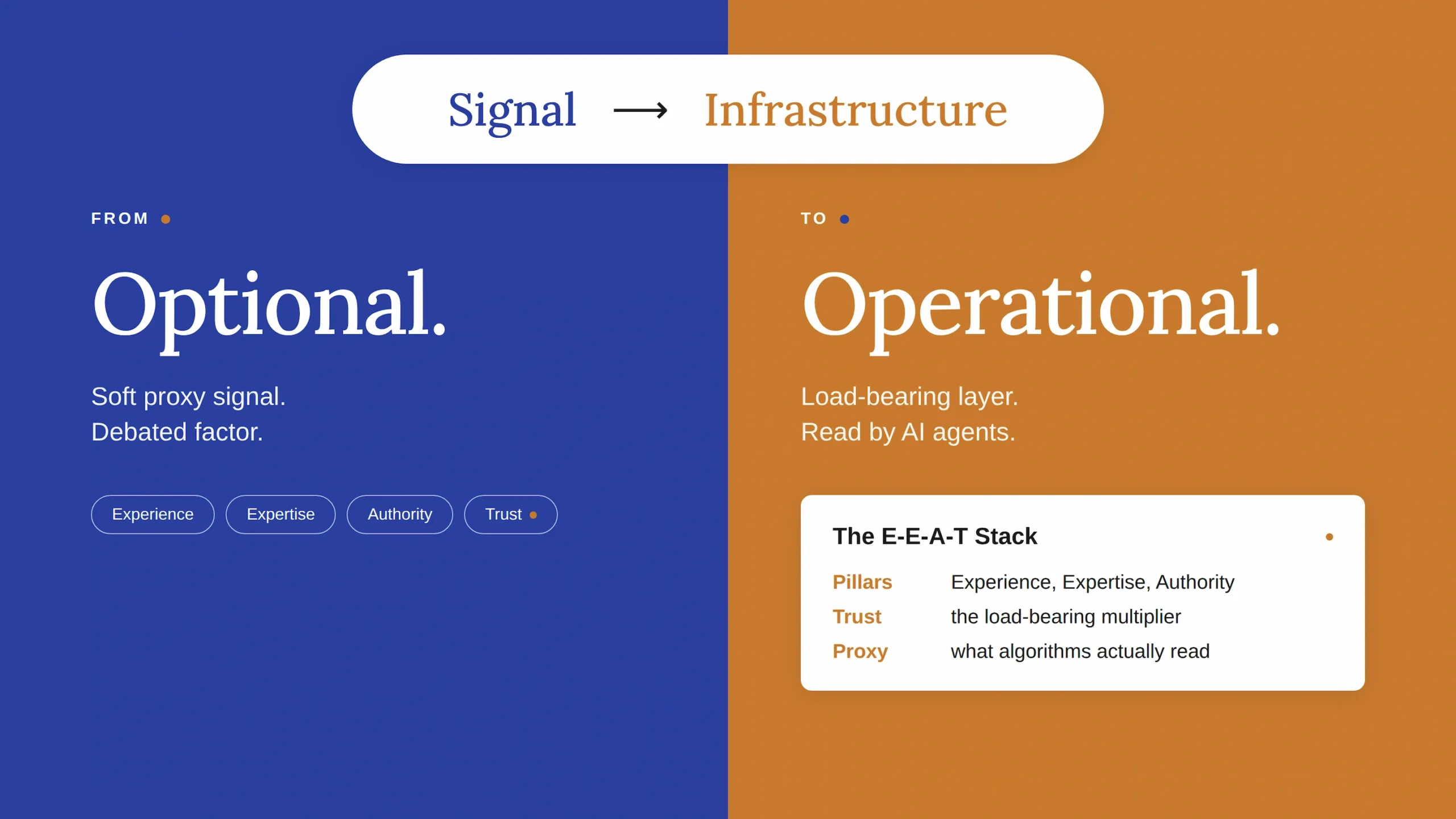
E-E-A-T is not a ranking factor. Google has said this in its Creating Helpful, Reliable, People-First Content documentation. And yet every senior SEO strategist I respect treats E-E-A-T as one of the most consequential pieces of work on a client site.
The contradiction has been tolerated for years because the stakes felt low. Sites without strong E-E-A-T signals did not get penalized; they got quietly outperformed during Core Updates, and most teams treated that outperformance as a content quality problem rather than an infrastructure problem.
The stakes are no longer low.
Specific AI retrieval pipelines, like ChatGPT search, have been observed to filter out roughly 83% of candidate URLs before they ever reach the LLM’s synthesis step (Jessier, Search Engine Land, May 2026). While Jessier identifies inputs like entity coherence and relationship density, in practice, this translates to the layer that has always sat under the E-E-A-T umbrella: schema integrity, author signal density, NAP consistency, content originality. While Google’s core algorithm uses these inputs as a moving weight inside organic ranking, independent agentic systems apply them as a retrieval threshold. The same proxy signals – two different gates.
Meanwhile, Gemini grounds in business websites and acts on the owner’s behalf inside Google Business Profile. Lighthouse shipped an Agentic Browsing audit category inside Chrome DevTools. The proxy signals that have been governing organic ranking for years are now also the signals that determine whether a business is retrievable, citable, and operable by AI systems at all.
E-E-A-T became infrastructure while most of the SEO industry was still arguing whether E-E-A-T counted as a “real” ranking factor.
How that happened is the rest of this blog post.
What Google Says About E-E-A-T (Read Directly, Not Through Secondary Interpretations)
One of the most useful exercises for anyone working in this space is to stop reading other people’s interpretation of E-E-A-T and read Google’s own documents directly.
From Google’s Creating Helpful, Reliable, People-First Content documentation:
“While E-E-A-T itself isn’t a specific ranking factor, using a mix of factors that can identify content with good E-E-A-T is useful.”
In the same Google documentation, on the relative weight of the four E-E-A-T pillars:
“Of these aspects, trust is most important. The others contribute to trust, but content doesn’t necessarily have to demonstrate all of them.”
The Google Search Quality Rater Guidelines PDF, section 3.4, adds:
“Trust is the most important member of the E-E-A-T family because untrustworthy pages have low E-E-A-T no matter how Experienced, Expert, or Authoritative they may seem.”
And on the role of the quality raters themselves, from the Google Creating Helpful Content documentation:
“Search raters have no control over how pages rank. Rater data is not used directly in our ranking algorithms.”
Read those four passages alongside each other. Google is saying two things at once. E-E-A-T itself is not a measurable input the ranking system takes. And Google’s automated systems try to identify content that demonstrates E-E-A-T using a mix of factors. The algorithm does not score “E-E-A-T”. The algorithm measures a set of proxy signals that, in aggregate, point at E-E-A-T.
The distinction is the part that almost every secondary write-up on E-E-A-T gets wrong, and the part that determines whether E-E-A-T work on a site moves anything that matters.
The E-E-A-T Proxy Signal Layer Algorithms Actually Read
E-E-A-T proxy signals are the observable indicators Google’s automated systems and AI retrieval pipelines pull from a page, a site, and the broader ecosystem around the site. These signals correlate with how Google’s quality raters evaluate the four E-E-A-T pillars.
The proxy signal layer is directionally well-established across the industry. The signals listed below are the ones SEO practitioners and the published research consistently identify as inputs that correlate with E-E-A-T evaluation. Their relative weights are not public.
The proxy signals that SEO practitioners most consistently observe as inputs:
- Author signals: Visible bylines on long-form content, product reviews, editorial pieces, and any YMYL (Your Money or Your Life) topic – finance, health, legal, safety, high-stakes areas. Author bios with relevant credentials. Topical match between author background and content domain (e.g., a financial article written by an actual accountant, not a generalist copywriter). Outward-facing verification via links to LinkedIn, Google Scholar, or professional registries.
- Brand mentions and citations: Volume, sentiment, and contextual quality of brand mentions across the web. A citation within an authoritative industry trade publication carries fundamentally different weight than a mention in a casual forum thread.
- Originality signals: First-hand experience language, primary source citations, original research, and unique imagery rather than stock photography. The QRG explicitly demands this level of primary proof for product and service evaluations.
- Freshness signals: Legitimate “Last Updated” timestamps tied to substantial content revisions. Conversely, the QRG notes that falsifying dates to mimic freshness without altering the core content is a direct trust violation.
- User satisfaction and real-world utility: Google does not use click and interaction data (handled by core mechanisms like Navboost) to calculate a direct E-E-A-T “score.” Instead, user behavior acts as a real-world reality check. Automated systems track signals of genuine user satisfaction – such as direct return traffic, sustained engagement, and a rise in branded search queries (e.g., “your brand + topic”). When these behavioral signals align, they validate that the site’s structural E-E-A-T claims match its actual value to real people.
- Trust architecture: The fundamental security and transparency layer of the domain. HTTPS deployment, transparent corporate ownership on an About page, accurate and consistent NAP (Name, Address, Phone) data, legal/editorial policies, and the complete absence of dark patterns or intrusive ads.
Where the signals live
Each E-E-A-T proxy signal lives at a different layer of the stack. Some live in the page itself (author bylines, byline-to-bio links). Others live in the site (legal policies, NAP, footer registration data). Still others live in the ecosystem around the site (brand mentions, sameAs density, third-party reviews).
All E-E-A-T proxy signals are observable. None of those signals is E-E-A-T itself.
The E-E-A-T Proxy Signals
Six observable inputs · weights not public
Visible bylines. Expertise match.
Bios with credentials. Topical alignment with content.
Volume and contextual quality.
Trade publication citation outweighs casual forum thread.
First-hand experience language.
Primary sources, original imagery over stock photography.
Real revisions. Not fake timestamps.
Falsifying dates without revision is a direct trust violation (QRG).
Real-world validation layer.
Return traffic, engagement, branded query growth.
Security and transparency layer.
HTTPS, About transparency, consistent NAP, legal policies.
What stays unknown about the weights
The weights Google assigns to each signal are not public. Nobody outside Google’s ranking team knows whether author bylines weigh more than brand mentions, or whether NAP consistency weighs more than freshness, or whether the multipliers shift by niche and YMYL classification. What the SEO industry has is the directional list of E-E-A-T proxy signals, not the multipliers.
The directional list is enough to decide where the work goes. The multipliers would be nice, but are not necessary.
Why Trust Is the Load-Bearing E-E-A-T Pillar
Of the four E-E-A-T pillars, Google has been unusually explicit about Trust:
“Of these aspects, trust is most important. The others contribute to trust, but content doesn’t necessarily have to demonstrate all of them.”
The Trust pillar deserves to be taken literally.
A site can have an exceptional author (Expertise), explicit first-hand qualification (Experience), and strong brand mentions in industry trade publications (Authoritativeness), and still fail E-E-A-T evaluation if the Trust layer breaks. No HTTPS. No transparent ownership disclosed on the About page. Dark patterns in checkout. Fake Freshness manipulation on the publication dates. Affiliate links without disclosure.
Trust is not an additive E-E-A-T component. Instead, trust is a multiplier. If Trust is zero, the rest of the E-E-A-T pillars collapse to zero regardless of how strong the other three look in isolation.
In Google’s traditional documentation, technical UX (Core Web Vitals, accessibility) and reputational E-E-A-T sit in separate evaluation pipelines under the broader “Helpful Content” umbrella, and Google’s core algorithm still evaluates them through distinct data pipelines. However, in the agentic web, these two infrastructures merge into a single point of failure.
For a Google Quality Rater, trust is reputational: who stands behind this content. For an LLM Agent executing tasks on the web, trust is functional: can the agent parse this DOM without getting trapped. An unreadable accessibility tree or severe layout shift under interaction means an agent cannot operate, which turns a technical UX flaw into a broken trust layer. The operational infrastructure and the reputational infrastructure become the same barrier to entry.
E-E-A-T in the Agentic Web: Three Shifts That Are Moving E-E-A-T From Soft Signal to Operational Infrastructure
Three concrete shifts transformed the role of E-E-A-T from a soft signal to an operational infrastructure. Each one moves the surface area where E-E-A-T proxy signals get measured, and what happens when they fail.
Shift one: AI retrieval pipelines disqualify based on E-E-A-T proxy signals before synthesis ever happens
In Myriam Jessier’s piece on Brand Depth in Search Engine Land, (which inspired my previous breakdown, Citations Are Receipts), the numbers worth sitting with are these: ChatGPT search expands a single query into five or six semantic variations, retrieves 35 to 42 candidate URLs, and disqualifies 83% of those URLs before extraction. Simultaneously, Google’s AI fan-out systems force your brand to compete across 8 to 12 parallel subqueries at once. Only 6% to 27% of frequently mentioned brands are also top-cited sources in AI answers, meaning models can know a brand without ever citing the brand.
The work that gets a site through the AI filtering stage is brand-depth work, which is sharpened E-E-A-T work. It is critical to draw a line here: while Google’s core algorithm uses proxy signals to adjust ranking weight over time, third-party agentic RAG systems (like ChatGPT Search) use these proxy signals as a retrieval threshold.
Sites with weak E-E-A-T proxy signals do not just rank lower in AI answers. AI retrieval systems completely filter out those sites before the model reaches its synthesis step. That filtering is a retrieval clearance problem, which is fundamentally different from traditional ranking optimization.
Shift two: RAG systems grounded in your business website now act on your behalf
Gemini’s Google Business Profile integration is the first concrete example of Google operationalizing the data integrity underneath E-E-A-T as a public-facing risk. The Business Notebook treats the business website as the knowledge base. Gemini grounds itself in the business website. If the business website is inconsistent or vague, Gemini’s grounding becomes unreliable, and the inconsistencies become public-facing through the Google Business Profile that Gemini manages.
The E-E-A-T data integrity work that an audit already prioritizes (entity coherence, consistent NAP, canonical service descriptions, structured presentation of facts) has become operationally relevant to how Gemini manages a Google Business Profile day-to-day.
This is the layer where E-E-A-T becomes a brand risk-management problem rather than a search-visibility problem. If AI agents draw incorrect or fragmented conclusions about a business because the underlying E-E-A-T architecture is broken, the business loses control over its own brand narrative inside AI surfaces. That is a brand risk concern, not just an SEO concern.
Shift three: Agent-readiness audits collapse old E-E-A-T categories
The Lighthouse Agentic Browsing audit shipped inside Chrome DevTools in May 2026.
The Mark van Berkel modern data stack series mapped the same architecture from a different angle.
Google Cloud’s Open Knowledge Format, published in June 2026, formalized the markdown-plus-YAML pattern as an open specification for agent-readable knowledge.
None of these are new E-E-A-T categories.
These are the technical surface areas where E-E-A-T proxy signals become operationally enforceable:
- Accessibility tree integrity.
- Cumulative Layout Shift during interaction.
- Entity coherence across the site’s structured data.
- Brand entity naming consistency across all canonical touchpoints (title tag, footer, About page, social profiles).
- Machine-readable Agentic Entry Points where applicable.
The work that compounds across all three shifts
The work that compounds across all three shifts is the same E-E-A-T work. Make the data underneath the business website accurate, coherent, and unambiguous. Make the data readable by humans, by Google’s automated systems, and by AI retrieval pipelines.
The audience for E-E-A-T is widening. The E-E-A-T work itself is not new.
What Is Verifiable, What Is Inferred, What Stays Black Box
Verifiable. Inferred. Black box.
Three levels of E-E-A-T certainty
Verifiable.
Documented in Google’s own docs.
- Automated systems use proxy signals to identify E-E-A-T.
- Rater data trains the systems, does not directly rank pages.
- Trust is the load-bearing pillar of the four components.
Inferred.
Consistent patterns. Not proof.
- AI retrieval pipelines use entity coherence as filter.
- Strong E-E-A-T sites tend to be more Core Update resilient.
- RAG-grounded systems perform better with consistent data.
Black box.
Unknown outside engineering teams.
- Exact mechanisms AI tools use to select sources for citation.
- Precise weights Google assigns to each individual proxy signal.
- Quality score thresholds for RAG retrieval eligibility.
What we can verify about E-E-A-T
Google’s automated systems use a mix of proxy signals to identify content with strong E-E-A-T. Quality rater data does not directly rank pages, but it trains the systems that do. Trust is the load-bearing pillar of the four E-E-A-T components.
What we can reasonably infer about E-E-A-T, based on the available evidence:
- AI retrieval pipelines appear to use entity coherence and brand consistency as filters before synthesis.
- Sites with stronger E-E-A-T proxy signals appear to be more resilient through Google Core Updates.
- RAG systems grounded in business websites perform better when the underlying E-E-A-T data is consistent.
What stays black box about E-E-A-T
- The exact mechanisms by which AI tools select which sources to cite.
- The precise weights Google assigns to each individual E-E-A-T proxy signal.
- The site quality score thresholds at which a site stops being retrieved as a RAG candidate at all.
Nobody outside the engineering teams at Google, OpenAI, and Anthropic knows the precise E-E-A-T mechanics. What the SEO industry has is the directional pattern. The directional pattern is enough to decide where the E-E-A-T work goes.
E-E-A-T in Traditional Search vs. the Agentic Web
For decision-makers and marketing leads who need the bottom line in one glance:
| Concept | Traditional Search (Organic) | Agentic Web (RAG / LLM) |
|---|---|---|
| Role of proxy signals | Moving weight in ranking algorithms | Retrieval threshold for AI synthesis |
| Trust evaluation | Reputational (who wrote this?) | Functional (can the agent parse this?) |
| Failure mode | Slow decline in organic traffic | Brand exclusion or AI hallucination |
| Business impact | Search visibility problem | Brand risk and operational failure |
Where E-E-A-T Work Leaves the Modern SEO Role
The role of an SEO and AI search strategist is narrowing toward foundational integrity. The work is to make sure the data AI systems read from your business ecosystem is accurate, coherent, and unambiguous. The standard is simple: whatever the model decides to do with the data should be worth signing your name to.
E-E-A-T is the load-bearing layer underneath the work that compounds. It is not a ranking factor. It is the infrastructure that determines three things:
- whether the proxy signals algorithms actually measure get strong enough to matter;
- whether a site clears the AI retrieval floor before synthesis happens;
- and whether a RAG-grounded agent acting on a business’s behalf has anything coherent to act on.
The shift from a soft E-E-A-T signal to E-E-A-T infrastructure happened quietly, and it is entirely reasonable if it has snuck up on your team.
The E-E-A-T work that compounds is the same work it has always been – but knowing what to fix first to clear the agentic gate is the part that has changed.
If you want a clear, prioritized read on where your site’s E-E-A-T proxy signals currently stand, the E-E-A-T Baseline Audit is where I start. It maps what AI retrieval layers and Google’s automated systems are reading – and filtering out – about your business right now, and what to fix first.
Get in touch to take back control of your brand’s AI narrative.