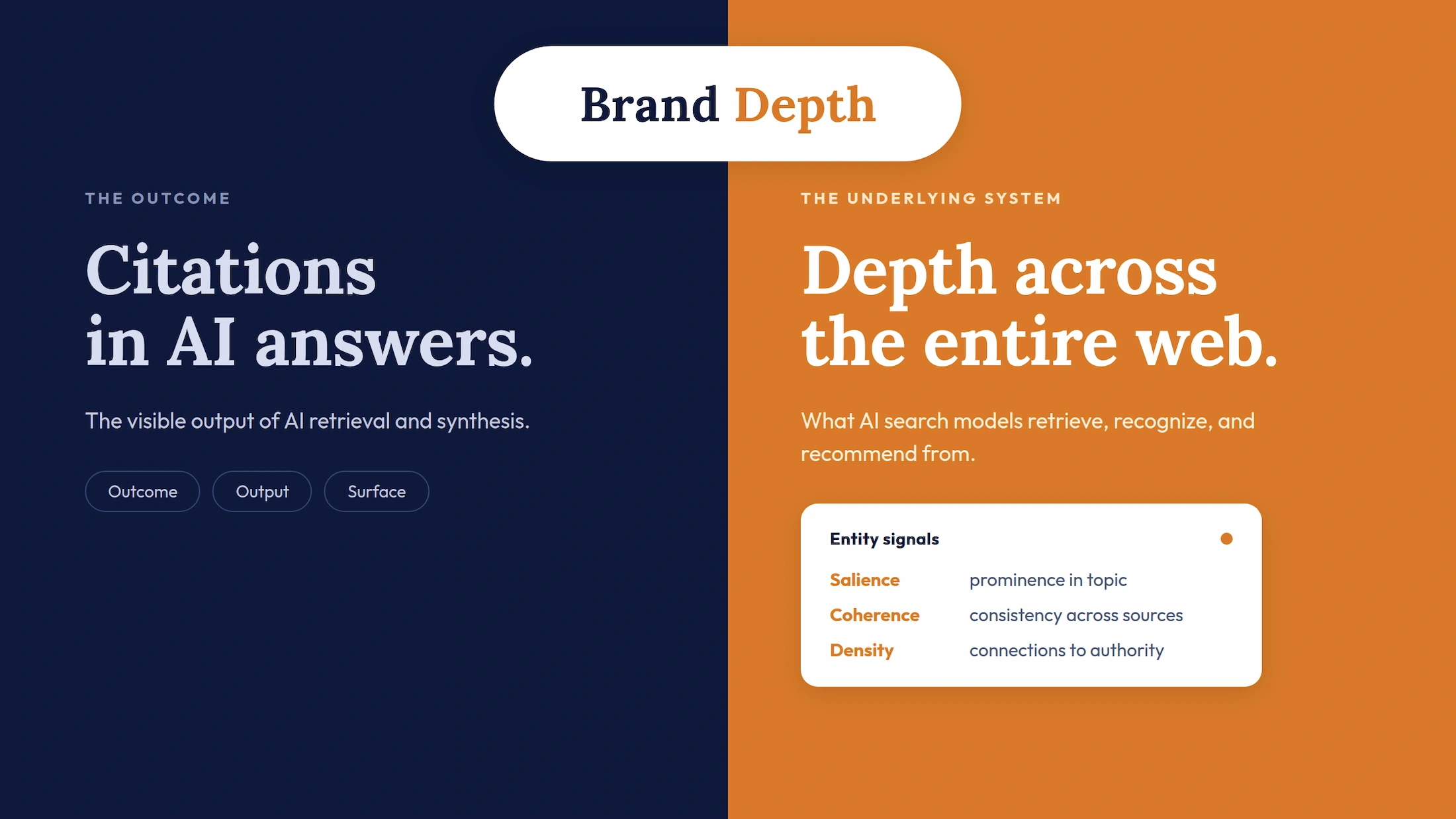
Myriam Jessier recently published a piece in Search Engine Land about how brand depth shapes what AI systems retrieve, recognize, and recommend.
Her argument, in short: citations show the outcome – that a brand surfaced in an AI answer. They don’t explain the underlying systems that produced that outcome.
She calls the underlying system – Brand Depth.
It’s worth pulling apart because her closing line – “build the thing that causes citations, not the thing that imitates them” – points to what an AI search audit should also be looking at.
What Brand Depth actually is
Plain version: it’s the density, consistency, and cross-source presence of your brand across the web – deep enough that AI systems treat you as the statistically low-risk answer for a topic, before any citation ever gets generated.
Myriam frames it as two games happening at once.
Game one is parametric weight: what an AI model has internalized about your brand during training. This is built slowly, over months and years, through consistent presence across the web. If your messaging is inconsistent, your brand’s vector in the model’s embedding space becomes fuzzy, and the model is less likely to recall you when a relevant topic comes up.
Game two is retrieval survival: what survives when systems like Google AI Mode, ChatGPT Search, and Perplexity actually fire their retrieval pipeline in real time. Each handles it slightly differently. Google AI Mode decomposes a single query into 8 to 12 parallel subqueries before synthesizing. ChatGPT expands a query into five or six semantic variations, retrieves 35 to 42 candidate URLs, and disqualifies roughly 83% before extraction. Perplexity retrieves and ranks first, then synthesizes from the retrieved context.
Different pipelines, same point: your brand has to win in both layers, and citation tracking only tells you about a subset of what happened on the output side.
The data behind why citations alone don’t explain visibility
Two numbers from her piece that are worth sitting with.
First: only 6 to 27% of brands frequently mentioned in AI answers are also top-cited sources. A model can know a brand, recommend it, and never link to it.
Citation frequency studies are useful as symptom trackers, not as diagnostic tools – they can show which brands appear more often, but not whether that visibility comes from training data, RAG retrieval, entity salience, or category dominance.
Second: roughly 85% of brand mentions in AI search come from external domains. Not from the brand’s own site. Which means the bulk of the work that drives AI visibility is happening off-page – in reviews, mentions, third-party coverage, and the broader entity context around your brand.
If you’re running AI search audits and the primary metric is “are we cited,” you’re measuring the receipt instead of the cash register.
The three things AI systems actually evaluate
Myriam pulls out three specific signals Google’s systems explicitly evaluate, and that LLMs appear to weigh in a similar way at inference time. They map directly to what an off-site audit should be looking at.
1. Entity Salience
Entity salience is how prominent your brand is within a topic cluster, not just on branded queries. Low salience means you only surface when someone searches your exact name. High salience means you surface when the topic itself comes up.
2. Entity Coherence
Entity coherence is the consistency of your brand’s identity across every place it appears on the web. Inconsistent naming, conflicting positioning, contradictory dates – these signal to the model that the entity is unreliable, and the model fills the gaps. That’s where brand drift happens: the model’s version of your brand slowly diverges from yours because the input signal was never stable enough to anchor your identity.
3. Inter-entity Relationship Density
Inter-entity relationship density is how many strong connections you have to other authoritative entities – products, certifications, people, places, proofs. In multi-hop agentic systems (Deep Research, AI Mode, Perplexity Pro), each reasoning step is a separate retrieval event. If your brand exists in isolation at the center of its own graph, it disappears the moment the query moves one step sideways.
The retrieval floor most audits don’t catch
Mark Williams-Cook documented a site quality score in December 2024 – a 0 to 1 scale where sites below roughly 0.4 aren’t retrieved as RAG candidates at all, regardless of how optimized the content is.
That’s the floor. It means tracking citations is meaningless if your site isn’t clearing the retrieval threshold in the first place. Brand integrity becomes an infrastructure problem before it becomes a content one.
What “high-entropy” content actually looks like
The most practical reframe in the piece, for anyone briefing content teams: AI systems skip generic content. They can generate it themselves. What they retrieve and cite is content the model can’t plausibly produce without a source.
Low entropy: “Our coffee is smooth and delicious.” High entropy: “The Gesha variety from Hacienda La Esmeralda in Boquete, Panama. Grown at 1,700 meters. Water at 94°C. Brew ratio 1:16.”
The second one anchors named entities – variety, organization, location, quantitative values. The model can’t make those up.
Myriam suggests structuring foundational content explicitly with what she calls the Entity – Attribute – Evidence pattern: “Brand X [Entity] is a carbon-neutral hiking boot company [Attribute] certified by ISO-14001 [Evidence].” It reads slightly mechanical, which is the point. Retrieval pipelines aren’t reading for prose, they’re reading for signal density.
A concrete extension Myriam suggests: treat assets like company history pages, team bios, and certification listings as grounding data for RAG systems – high-density material designed to be retrieved.
What this could mean in practice
A few practical shifts I’ve been thinking about for my own audits and strategy setting.
- Citation tracking stays in the audit, as one of the visibility outcomes worth watching. The shift is in what sits alongside it: the off-site entity signals and on-site retrieval conditions that seem to produce those citations in the first place.
- Off-site entity work moves up. If 85% of brand mentions come from external domains, then naming consistency across third-party sources, third-party coverage density, presence in authoritative datasets, and entity coherence across review platforms and trade publications all start to matter as concretely as anything on the site.
- Internal linking gets evaluated as a knowledge graph, not just as crawl-budget routing. The decision journey (topic → subtopic → product → review → trust signal → organization) is a useful frame for whether your internal structure mirrors how an AI system would actually traverse the topic.
- Pages with no meaningful incoming internal links don’t accumulate siteAuthority or NavBoost signals – they get demoted in processing, or skipped entirely.
- And content briefs change shape. Less “write 1,500 words on X.” More: which named entities, certifications, specific quantitative claims, and proof points need to be present on this page, in what configuration, to make it retrievable for the queries that matter.
The honest read
Brand Depth isn’t a new optimization category. It’s the older work – entity consistency, off-site presence, semantic depth – sharpened for systems that synthesize before they cite.
If you’ve been running AI search work primarily through the lens of “are we showing up in answers,” Myriam’s piece is worth a slow read – it adds the layer beneath that question.
If you want a clear, prioritized view of where your site and your brand actually sit in this funnel – including which work compounds and which work is just residue – that’s the kind of audit I do.