Google just announced that Gemini can now manage a Google Business Profile directly. Owners connect the profile inside the Gemini web app, then ask Gemini to update hours, draft review replies, publish Google Posts, or surface the search keywords customers are actually using to find them. The rollout is gradual, ships with real constraints, and is worth understanding clearly before clients start asking about it.
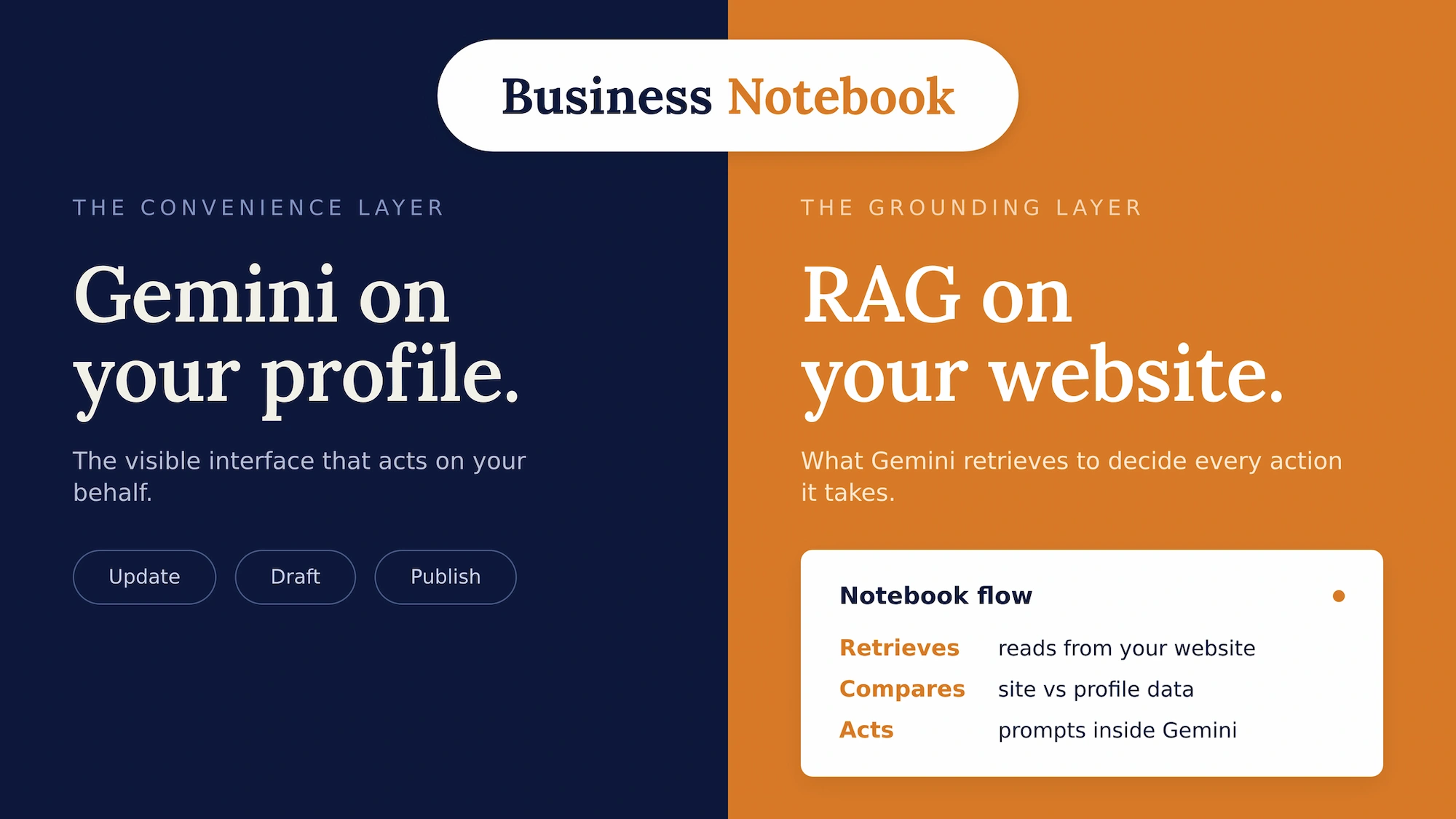
Most of the headline coverage of Gemini’s Google Business Profile integration stays on the convenience layer. The shift I want to spend time on sits one level below that convenience layer, in the system that decides what Gemini reads when it acts on a profile.
What Gemini can actually do inside Google Business Profile
Gemini’s Google Business Profile integration covers three concrete capability domains, all documented on Google’s official support page.
Profile management is the first domain. Gemini updates business hours (including special holiday hours), edits business attributes such as “outdoor seating”, “Wi-Fi”, or “happy hour”, modifies contact info and action links, creates and deletes menu sections for food businesses, and uploads photos via public URL.
Customer engagement is the second domain. Gemini drafts replies to reviews (with brand-voice instructions supplied by the account owner) and creates, schedules, publishes, or deletes Update, Offer, and Event posts directly inside the Google Business Profile.
Insights are the third domain. Gemini pulls performance metrics such as impressions, website clicks, direction requests, and bookings, synthesizes themes from review content (what customers praise, what they criticize), and returns the specific search keywords driving discovery to the business.
The insights capability is the one I’d pause on. Synthesized review themes plus exact discovery keywords, surfaced together in one conversational interface, is a meaningful upgrade over what the existing Google Business Profile dashboard makes easy.
Why Gemini’s GBP integration is a category shift, not a feature update
Gemini’s Google Business Profile integration changes the category of what AI does inside Google’s product surfaces. For the past eighteen months, AI inside Google products has mostly interpreted queries and synthesized answers on a results page. This integration is something different. Gemini now sits between the business owner and the dashboard, and the interaction model moves from clicking through a UI to instructing an agent that acts on the UI on the owner’s behalf.
The interesting part of Gemini’s Google Business Profile integration isn’t the chat interface itself. The interesting part is the data Gemini reads when deciding what to do inside the profile.
How the Business Notebook works as a RAG system over your website
The Business Notebook is the strategic core of Gemini’s Google Business Profile integration, and most of the early coverage barely touches it.
When a business owner creates a Business Notebook inside Gemini, Gemini asks for the URL of the business website. From that moment on, Gemini uses the business website as a knowledge base to ground its understanding of the business. The Business Notebook then proactively flags issues: missing holiday hours, unanswered customer questions, mismatches between what the business website claims and what the Google Business Profile actually says.
Read that mechanic again. The Business Notebook is retrieving from a business website, comparing what Gemini finds on the website to the structured Google Business Profile data, and surfacing the inconsistencies as actionable prompts inside the Gemini interface.
In plain terms, the Business Notebook is RAG (retrieval-augmented generation) applied to local search. Same architecture as the AI search systems strategists have been auditing for over a year, just pointed at a contained, business-specific dataset.
What the Business Notebook means for website data integrity
The Business Notebook’s RAG behavior creates concrete data integrity requirements for any website that gets grounded into Gemini.
If a website’s content is inconsistent, contradictory, or vague, the Business Notebook’s grounding will be unreliable. The Business Notebook may auto-suggest the wrong holiday hours, draft review replies that misstate the business’s services, or recommend post copy that doesn’t match what the business website actually offers.
If a service area, opening hours, pricing, or product list is described differently across the homepage, the location pages, and the footer, the Business Notebook has no way to know which version is canonical. The Business Notebook will pick one version, or reconcile the versions on its own, and that reconciliation becomes the version Gemini acts on inside the public-facing Google Business Profile.
The data integrity work that AI search audits already prioritize – entity coherence, consistent NAP data, canonical service descriptions, structured presentation of facts – just became operationally relevant to how a Google Business Profile gets managed day to day. Not eventually. Now.
The fine print on Gemini’s GBP integration most coverage skips
Gemini’s Google Business Profile integration ships with constraints that matter more than the headline features for anyone preparing client conversations.
The one-profile rule is the biggest constraint. Gemini’s Google Business Profile integration works if and only if the Google account being used has access to a single verified Business Profile. Multi-location businesses, franchises, and agency-managed accounts are excluded at launch.
The personal-account rule is the second constraint. Gemini’s Google Business Profile integration does not yet support Google Workspace (work or school) accounts. The login has to be a personal Gmail that holds owner or manager rights on the profile.
The EEA and UK exclusion is the third constraint. Google’s rollout of Gemini’s GBP integration is global with the exception of the European Economic Area and the United Kingdom, almost certainly tied to the Digital Markets Act and UK competition law, in line with how Google has geo-blocked other AI features at launch.
Smaller prerequisites are also worth knowing. The Google account must be eighteen or older, and “Keep Activity” must be enabled. Gemini won’t connect to Google Business Profile without these settings in place.
For the segment of the market this currently reaches – single-location businesses outside the EEA and UK, owned through a personal Google account – Gemini’s GBP integration is rolling out this month.
What changes for SEO and AI search work after Gemini’s GBP integration
A few practical shifts I’ve been thinking about for my own audits and client conversations.
Why an AI search audit must now cover the Business Notebook
A local SEO audit historically checks NAP consistency, citations, review velocity, and on-page local signals. With the Business Notebook in the picture, an AI search audit also needs to check three additional dimensions:
- cross-source content consistency between the business website and the Google Business Profile,
- the semantic clarity of service and product descriptions on the business website,
- and the presence of the specific entity context the Business Notebook can reliably ground from.
The Business Notebook is now part of the audience an AI search audit serves.
Why brand voice becomes a documentation problem for Gemini’s review drafts
Gemini can draft review replies in a business’s brand voice, but only if that brand voice has been articulated somewhere Gemini can read. Suitable grounding sources for Gemini include the business’s website copy, a published tone-of-voice guide, and existing long-form content.
If the brand voice lives only in the heads of the people who manage the accounts, Gemini’s drafted review replies will be generic at best and off-brand at worst. Brand voice has just become a documentation requirement, not only a stylistic preference.
Why Gemini’s GBP integration is the template, not a one-off
Gemini’s Google Business Profile integration is the first concrete, shipped instance of Google operationalizing the convergence of Search, Gemini, and agents into a single product surface that Sundar Pichai has been describing publicly for months.
Gemini’s GBP integration is the template for what other Google product surfaces are likely to look like once Google extends the same model to Search Console, Merchant Center, and Google Ads dashboards.
Where Gemini’s GBP integration leaves SEO and AI search strategy
The convenience layer of Gemini’s Google Business Profile integration is real. For a portion of the market, the Google Business Profile dashboard is genuinely being abstracted away by Gemini. A business owner running a single-location business in a supported region with a personal Google account will save hours of manual dashboard work.
The strategic layer is the more interesting story. Google has quietly shipped a RAG system that uses the business website to ground Gemini’s understanding of the business, then acts on that understanding inside the public-facing profile. The quality of the website substrate determines the quality of what Gemini does in the business’s name.
The role of an SEO and AI search strategist isn’t disappearing because of this. The strategist role is narrowing toward the work that compounds: making sure the data Gemini reads from the business ecosystem is accurate, coherent, and unambiguous enough that Gemini’s automation produces public-facing results worth signing your name to.
If you want a clear, prioritized read on where your business website and your Google Business Profile currently sit relative to what the Business Notebook is reading – and where the gaps will start to cost your business once Gemini’s GBP integration reaches your region – contact me.