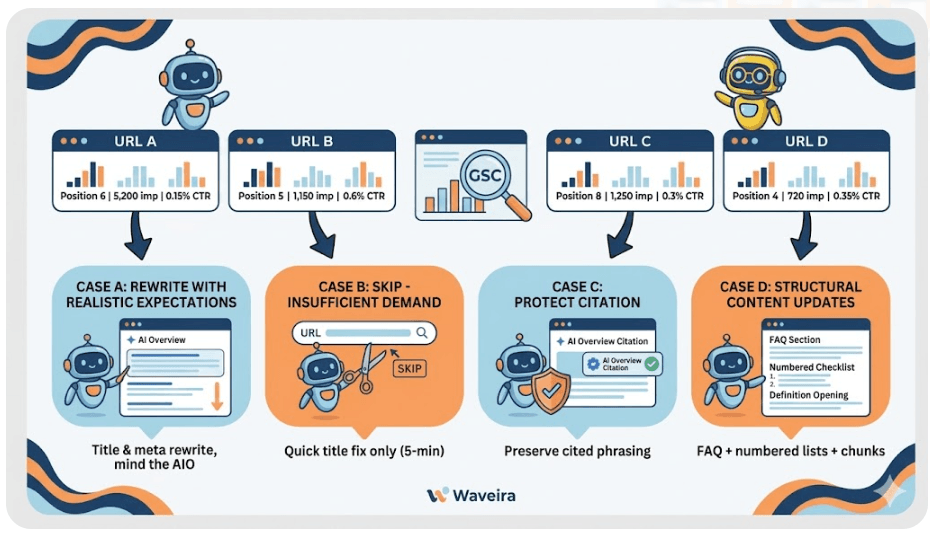
A page on position 6 with about 5,200 impressions and a CTR of 0.15%. Standard SEO advice would say: rewrite the title, sharpen the meta description, watch the CTR climb. That advice has been the default for “low-hanging fruit” audits for almost a decade.
It doesn’t work the way it used to.
In a recent audit for a client, I eventually worked through four URLs that looked identical on paper – all sitting on positions 1-10, all with high impressions but low CTR, all flagged by the same kind of report you’d pull from Google Search Console on any given audit cycle.
Four URLs – same metrics range, same default playbook recommendation – turned out to need four fundamentally different strategies once I looked past the surface-level filter. The standard “rewrite the title” approach would have been wrong on three of them, and damaging on one.
Here’s the workflow I applied, what it surfaced, and the framework that’s replacing the old CTR optimization playbook in 2026.
“Low-Hanging Fruit” Means Different Things in Different Tools
Most SEO tools surface “low-hanging fruit” reports, but they don’t define the term the same way.
Ahrefs and similar keyword tools flag terms where a site already ranks but not well enough to capture clicks – typically pages in striking distance of better placements, with reasonable search volume behind them. The lens is keyword-level: which terms is the site close to ranking better for, and which target pages handle them.
Google Search Console gives you a different view. The Pages report shows URL-level performance: which pages already get impressions, what their average position is, and whether their CTR is under- or over-performing relative to that rank. The lens is page-level: which URLs are already visible to users but not getting the clicks they should.
None of these reports gives you a complete picture on its own. Ahrefs and keyword-level tools see the external world (who ranks where, keyword difficulty, competitor authority). GSC sees what’s actually happening on your site (real impressions, real clicks, real positions averaged across all queries).
For this audit, I worked on both tracks in parallel. The Ahrefs track produced its own findings and decisions. This post is about the GSC track, and specifically about the first phase of GSC work: URLs already ranking on page one but underperforming on click-through.
From 127 Pages to 4: The GSC Triage
The site had 127 URLs returning impressions in GSC over the audit period. Working through 127 URLs one by one is how SEO audits become billable disasters. The first job is triage.
I applied two filters:
- Filter 1 (CTR opportunity): position 1-10, impressions ≥ 500, CTR meaningfully below the expected baseline for non-branded rank (rough rule: CTR under 5% for positions 4-10, under 10% for positions 1-3).
- Filter 2 (rank push opportunity): position 11-20, impressions ≥ 1,000.
Filter 1 produced 9 URLs. Filter 2 produced 10 URLs – none overlapped, leaving 19 unique candidates before any judgment was applied.
The SKIP Matrix: Why Most Audits Waste Time
Then I ran the SKIP matrix. Most “low-hanging fruit” tutorials skip this step entirely, which is why most “low-hanging fruit” audits waste hours on URLs that shouldn’t be touched.
Four reasons a URL drops out of the active queue:
SKIP service pages – on this site. The internal team agreement was that service pages have their own content workflow. On a different site without that workflow, service pages might be the primary focus, not the skip.
SKIP case studies. These follow a freer narrative format and prioritize authority and social proof over traditional search visibility. Optimizing them for CTR misses the point of why they exist.
SKIP navigational pages (about-us, contact). When these appear in low-CTR audits, the issue is usually SERP-selection: Google is prioritizing the homepage for branded queries, or the user is getting the info they need via Sitelinks. That’s not a CTR problem—it’s a different intent-mapping problem entirely.
SKIP index pages (/blog/, /guides/). These are aggregation hubs with CTRs near zero by design—users search for specific answers, not a directory of links. A low CTR on a category index isn’t an anomaly; it’s a function of its role in the user journey.
That accounted for 7 URLs out of the 19.
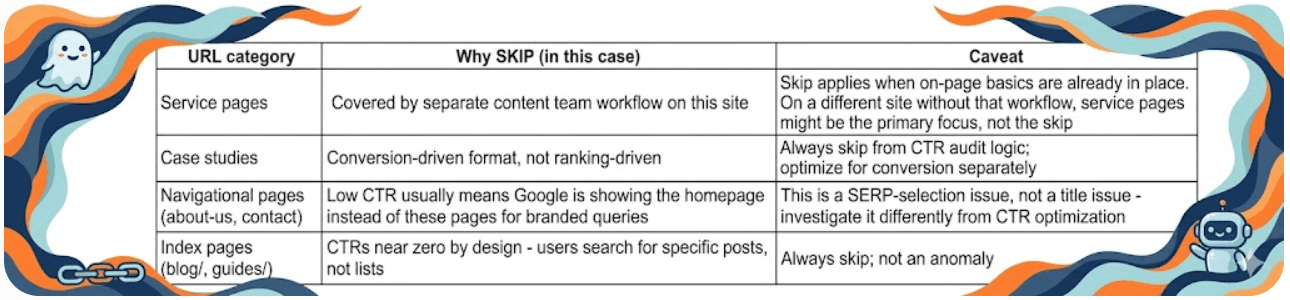
Note: This SKIP matrix isn’t universal. The categories that drop out depend on internal team agreements and the specific site context. On this audit, service pages dropped because the content team had a separate workflow. On a different site, service pages might be the primary focus. Apply the categories as a starting checklist, not as fixed rules.
I also dropped one URL for a page-specific reason: it was showing strong organic momentum on its own. When a page has natural growth signal that Google is picking up, intervention introduces risk without proportional reward. The default for those should be “let it ride” until growth stalls.
That left 4 URLs in phase A (the CTR optimization track) and 7 in phase B (the rank push track).
Phase B is much more involved than phase A – it requires keyword research, internal linking audits, content quality review, schema, and freshness work, often paired with content team handoff. Each track deserves focused treatment.
I’ve also written about GSC indexing reports prioritization – a different GSC-driven audit angle, complementary to this one.
4 URLs That Looked Identical on Paper
Here’s what the 4 phase-A-candidates looked like before any analysis:
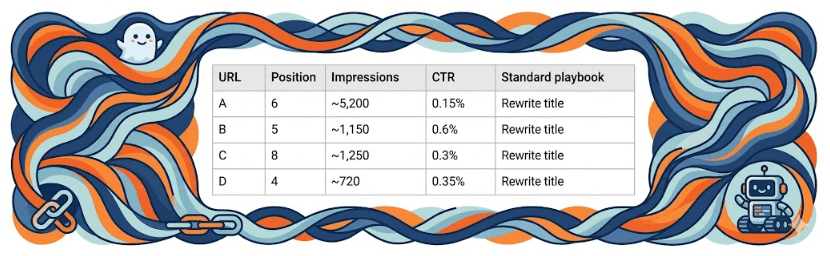
The standard playbook would have produced 4 identical title rewrites.
The actual audit produced 4 different strategies, each driven by what the per-URL diagnosis surfaced.
Case A: When AI Overview Eats the Above-the-Fold
URL A: position 6, around 5,200 impressions over the audit period, CTR of 0.15%. The standard interpretation: page is well-positioned but the title isn’t compelling enough.
The actual SERP architecture told a different story.
For the primary query this page targets, the live Google results page leads with an AI Overview citing five different brands – none of which is the client. Below the AI Overview, four sponsored ads occupy the next visible band of screen real estate. Then the organic results begin. By the time a user scrolls to position 6, they’ve passed an AI-generated answer with five linked competitor recommendations and four paid promotions for direct competitors.
CTR of 0.15% in this configuration isn’t an anomaly. It’s mathematically expected.
There’s a second finding worth noting. Google was already rewriting the page’s title in the SERP. The title configured in the site’s SEO plugin was 65 characters; Google was displaying the H1 (57 characters) instead. Title rewriting is normal Google behavior – studies have measured the rate anywhere from 30% to over 60% of SERPs, depending on methodology and time period. What matters here is that Google may rewrite what you submit, so you’re not writing the title that will display with 100% certainty – you’re giving Google enough material to choose from.
Technical Note: GSC Pages report and Queries report don’t add up
URL A’s Pages report showed the full impression count. After filtering by URL in the Queries tab, the impressions across visible queries summed to far less. The gap isn’t a bug. It’s GSC’s privacy threshold: queries with very low individual volume are hidden as anonymous queries to protect user identification. Pages report shows total impressions, Queries report shows only the queries that cleared the threshold. On URL A, the gap exceeded 60%. This is typical for long-tail-heavy pages where hundreds of unique, low-volume queries fall below Google’s privacy threshold.
Redefining Visibility: The “User-Perceived Ranking” Factor
Strategy applied: title rewrite plus meta description rewrite, with realistic expectations. AI Overview is occluding most above-the-fold space. The page sits on a position that’s effectively much deeper in user-perceived ranking. Based on what comparable rewrites have produced in past audits, the optimistic outcome is moving CTR from 0.15% to maybe 0.5-0.6%.
That’s a handful of additional clicks per month, not the dramatic gains the old playbook would project. Still, this is the direction SEO is moving in 2026 – the SERP is more crowded, the wins are smaller per intervention, and the work shifts toward AI search visibility (the next case studies make this clearer).
H1 stayed untouched. The page’s site architecture and internal linking structure were already sending a clear semantic signal to Google. Since the problem in Case A was external (SERP architecture – AIO and ads pushing organic results down), not internal (content relevance), changing the H1 risks disturbing that core semantic signal with no obvious upside.
Case B: When the Page Already Has What It Needs
URL B: position 5, around 1,150 impressions, CTR of 0.60%. Same playbook recommendation: rewrite title.
The query-level view changed the diagnosis.
After pulling per-query data, the primary query had only around 25 impressions and the page was sitting at position 3 for it. Most other queries this URL captured had impressions in the single digits or low double digits. Total actionable impressions across all the URL’s queries amounted to around 80 – well below the threshold where a CTR rewrite moves the needle.
There was also one diagnostic flag in the data: a site search query (site:domain.com) appearing in the top 5 with around 20 impressions. That’s internal team activity, not external user demand. Filtering it out reduces real impressions further.
The 93% Gap: Filtering Actionable Demand vs. Statistical Noise
What this case taught me about the filter itself
URL B passed the position-and-CTR filter on the strength of around 1,150 total impressions. But useful impressions – excluding site-search noise and one-off long-tail queries – were closer to 80. That’s a roughly 93% gap between what the filter measured and what was actually optimizable. A better filter would look at impressions on the URL’s primary query, not total page impressions. Total impressions can be inflated by long-tail noise that no CTR rewrite will ever convert.
The page already ranks well for what little demand exists. The title is technically too long, but that’s a quick mechanical fix, not a strategic overhaul.
Strategy applied: SKIP from the full rewrite track. The action item was a quick title shortening (under 60 characters) – a 5-minute mechanical fix that doesn’t require SERP analysis. Meta description rewrite was skipped because, unlike Case A, this URL’s demand is too low to justify the analysis time a meaningful meta rewrite needs. Time saved went into URLs where impressions were high enough for rewrites to matter.
The wider point: insufficient demand is a legitimate reason to skip a CTR audit even when the URL technically passes the position-and-CTR filter. Volume floor matters, and so does the kind of volume.
Case C: When You’re Already Cited in AI Overview
URL C: position 8, around 1,250 impressions, CTR of 0.30%. The playbook would say: rewrite the title.
Meanwhile, the live SERP showed something more interesting.
For the primary query this page targets, Google’s AI Overview was citing the client URL directly. The phrase the AI Overview highlighted matched phrasing used in the page’s H1 and body content. Google’s AI system was already extracting this URL’s content and presenting it as part of the answer above the organic results.
There were no sponsored ads on this SERP, which is consistent with informational rather than commercial query intent. The competitive landscape was Reddit threads, opinion-style articles from established SEO publications, and a handful of agency blog posts.
This changes the optimization goal. The standard playbook treats CTR rewrite as a free win – replace what’s there with something better, watch CTR rise. But when AI Overview citation is in play, the rewrite has to be evaluated for its impact on the citation signal too.
AI Overview doesn’t appear to extract citations from titles – it tends to lift content from body text and structural elements (headings, structured data, definitions). Aggressive H1 or body content rewrites that drift away from the language Google’s AI has latched onto can break the semantic match – this is what I’ve observed across audits, not a Google-stated mechanism.
Protective Optimization: Safeguarding Earned Semantic Signals
The framework I applied:
- Keep H1 untouched (this is where the AI Overview match is rooted)
- Keep the cited phrasing intact
- Refresh the title to consolidate the same semantic signal in a tighter form
- Use the meta description to expand on a unique angle (recovery steps, breakdown by issue type) that distinguishes the page from competitors
A note on AI Overview citation behavior
Google has not published explicit guidance on which signals drive AI Overview citation selection beyond stating that AI features use the same systems as Search and follow the same quality guidelines. What I’m describing here is an observed pattern, not a Google statement: pages that match the language used in the AI Overview answer text – especially specific phrases that appear both in the answer and in the cited page’s headings or body – tend to be cited more reliably across audits. Rewrites that preserve those phrases preserve the citation; rewrites that replace them risk breaking it.
Strategy applied: title rewrite that retains the cited phrasing in tightened form. Meta description rewrite that adds a unique angle competitors don’t cover. H1 stays. Monitoring set up to verify AI Overview citation stability for 14 days post-implementation.
Case D: When Half the Traffic Doesn’t Click
URL D: position 4, around 720 impressions, CTR of 0.35%. By the playbook’s logic, this should be one of the easiest CTR fixes in the set – already quite high on page one, low CTR, run the rewrite.
The query-level data showed the page wasn’t really doing what the playbook assumed.
Of around 35 distinct queries returning impressions on this URL, more than half had structural patterns that don’t match natural human search behavior. Geographic prompt fragments appended to the actual question (a country location specified at the end of a query). Long, fully-formed sentences that read like prompts, not searches. Multi-clause questions covering several aspects of one topic.
These queries reflect a Conversational Shift in how search is happening. Whether they come from advanced users treating Google like a chatbot interface, or from AI agents (ChatGPT search mode, Perplexity, Gemini’s grounding system) using Google’s index to compose answers for their own users, the format is the same – and so is the result: a zero-click SERP. Without server log analysis with user agent strings, the exact split between human and agent traffic is hard to call. What is consistent is the search behavior pattern this URL is exposed to.
More than half of this URL’s total impressions came from this kind of conversational query.
Technical Note: How conversational queries appear in GSC
Three patterns make conversational queries identifiable in GSC’s Queries report:
- Geographic prompt fragments: a country location specified at the end of a query, sometimes with language instructions like “reply in english”
- Conversational sentence structure: queries that read as full sentences with multiple clauses, often with question marks, rather than the 3-5 word fragments humans typically type
- Domain-specific terminology used precisely: standard searches often use shorthand and slang, while conversational queries tend to use the exact technical term
These patterns started appearing in GSC data noticeably during 2024 and have been growing across the audits I’ve worked on through 2025-2026, in line with broader AI search mode adoption.
These conversational queries trigger a different SERP behavior. Because the query is so specific and multi-clause, Google aggressively triggers comprehensive AI Overviews that satisfy intent above the fold. These have become massive zero-click queries. Title rewrites don’t influence this behavior – the click-through metric was never on the table for that traffic, regardless of whether the query came from a human or an agent.
Designing for the Conversational Shift and AI Agent Retrieval
The optimization for this conversational, high-AI-Overview traffic is structural. Content needs to be highly parseable by Google’s extraction models to increase the chances of being the primary citation in that zero-click AI Overview. You need clear definitions in the first 100 words, FAQ sections matching these multi-clause phrasings, numbered checklists, and comparison sections. Most importantly, content should be self-contained at the section level – each H2 should make complete sense without depending on the rest of the article. This is how Google’s AI chunks pages for retrieval and citation.
I noticed something else worth flagging during this audit. Running similar queries in two formats – traditional keyword phrasing versus conversational with geographic and language modifiers appended – produced visibly different SERPs in this specific case. Different AI Overview citation sets, different sponsored ad density, more prominent forum and Q&A results on the conversational version, and a “Missing: [keyword]” notification flagging that none of the top results perfectly matched a specific word.
This is one observation from one audit, not a systemic Google policy I can cite. But the implication is worth noting: visibility for conversational queries may not behave the same as traditional search visibility, even for the same underlying intent. Worth tracking on future audits.
Strategy applied: title rewrite (handles the traditional search share), meta description rewrite, and a content brief for the content team covering LLM-parseable structure (FAQ section, numbered checklists, definition-first opening, comparison sections, self-contained chunks). A dual-track optimization strategy: title and meta for human click-through, and structural chunking for AI agent retrieval.
The Decision Matrix Behind These 4 Cases
Four URLs, all looking identical at the start, produced four different strategies.
The variable that changed the strategy wasn’t position or CTR – those were similar. What changed the game was a new diagnostic layer that looks beyond the traditional metrics.
What the Old Playbook Misses
The “Filter pos 1-10 + low CTR = rewrite title” formula is still a useful starting point. However, it falls short because it assumes all URLs passing that filter need the same treatment. To avoid “billable disasters” and ineffective work, I apply four diagnostic checks that the old playbook doesn’t include:
- Traffic composition. What share of impressions comes from traditional search versus conversational, multi-clause prompts? When the conversational share is high, title rewrites stop being the primary lever, and we shift toward content structure and “atomic” chunking.
- SERP composition check. What does the actual SERP look like? On a SERP where AI Overview, ads, and sitelinks push the first organic result below the fold, position 6 means something entirely different than on a “clean” page. We are evaluating the “organic breathing room” left for the user.
- Demand floor check. Are there enough impressions on the primary query to produce statistically meaningful results? Below a certain threshold (around 100 impressions per primary query), CTR fluctuates more from noise than from intervention. We only spend billable hours where the volume justifies the deep dive.
- AI Overview citation status. Is Google’s AI already extracting this URL as a primary source? If yes, the goal shifts from “winning the click” to “protecting the citation” by preserving the semantic match.
A Layer, Not a Replacement
That said, this isn’t a replacement for the old playbook. It’s the layer that comes before applying it. Once these four variables are diagnosed, the standard CTR optimization tactics still apply – they just get applied differently per URL.

The Framework, Condensed
If you’re working through your own GSC low-hanging fruit list:
- Pull the Pages report and apply two filters (CTR opportunity vs rank push opportunity). Don’t analyze 100+ URLs as one undifferentiated list.
- Apply the SKIP matrix before any per-URL work. In this audit, service pages, case studies, navigational pages, index pages, and pages with strong organic momentum dropped out by category – but the exact list depends on the site and internal team agreements. Skip is contextual, not universal.
- For each remaining URL, pull per-query data through GSC’s URL filter, then run a live SERP check using the locale that matches your target audience (incognito, with the appropriate gl= parameter), and pull a SERP overview from your keyword tool. Both views are needed – one shows what Google currently displays, one shows authority context.
- Diagnose first across the four variables (SERP composition, demand floor, AI Overview citation, traffic composition), then prescribe.
- Recognize that title and meta rewrite is one of four possible actions, not the default. SKIP, citation-protective rewrite, and dual-track optimization (traditional title rewrite + structural updates for conversational queries) are equally valid outcomes.
- Document the per-URL decision: position, key SERP findings, strategy applied, expected outcome. Implement, request reindexing through GSC’s URL Inspection tool, monitor for 14 days.
Key Takeaways
- “Low-hanging fruit” reports from different tools surface different kinds of opportunities; running GSC and keyword-tool tracks in parallel produces a more complete picture than either alone.
- Triage with a SKIP matrix before per-URL work. The exact share that drops out depends on context, but a meaningful portion of automated-filter candidates often shouldn’t be worked on – in this audit, it was around 40%.
- CTR benchmarks from the pre-AI-Overview era don’t translate cleanly to 2026 SERPs. Position 6 on a SERP with AI Overview plus four sponsored ads above it isn’t the same position 6 it was three years ago.
- The Conversational Shift in search behavior is now visible in GSC – the multi-clause patterns are recognizable once you know what to look for. Pages with a significant share of these queries need content-structure work to compete for AI Overview citations, not just title-and-meta rewrites.
- AI Overview citation, once earned, becomes an asset to protect during optimization. Aggressive rewrites that break the semantic match Google’s AI has latched onto can produce net losses even when CTR improves on paper.
The Bottom Line: Diagnosis Before Prescription
The CTR optimization playbook from 2020-2022 assumed a stable SERP architecture. Position determined visibility. Title determined click-through. Both of those assumptions are weaker now. Position is a coordinate on a screen that increasingly contains AI-generated answers, expanded ad inventory, and feature blocks competing for attention. Click-through is one metric among several – and on a growing share of pages, it’s not even the dominant signal anymore.
The four URLs in this audit looked the same when filtered through automated criteria. They turned out to need four different strategies. The SERP they live in isn’t uniform anymore. Neither is the traffic they receive. The SEO work in 2026 is upstream of the rewrite – it’s in the diagnosis that decides whether a rewrite is the right move at all.
Pattern recognition saves the day.
Diagnosis saves the audit.
_________________________________________________________________________________________
I take on clients for SEO & AI Search readiness consultations.
If your audit recommendations look identical across URLs with different SERPs, you have a diagnosis problem – not a writing problem. Let’s look at what’s actually happening on those SERPs – let’s start from here.
_________________________________________________________________________________________